Address
Blyth, Northumberland
U.K. NE24 2QW
Telephone
+44(0)1670 336766
Opening Hours
Monday to Friday: 08:00 - 17:30

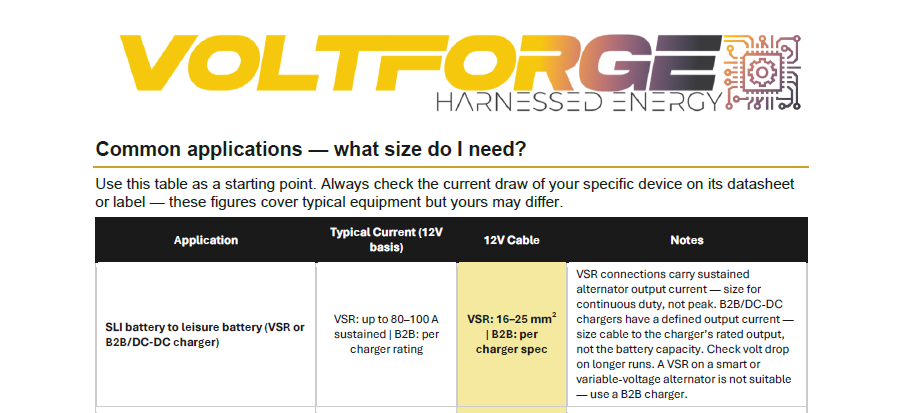
12V campervan cable sizing reference — cable sizes for common leisure vehicle applications, current rating table and volt drop guidance
Picking the right cable comes down to two things: how much current it needs to carry, and where it’s going to run. Get those right and the rest follows.
Current carrying capacity — ampacity — is a thermal limit. Too much current through too small a cable generates heat. Enough heat and the insulation fails, and that’s how fires start. Cables are cheap. Vans are not.
When in doubt, go up a size. A cable running slightly under its rating runs cooler, lasts longer, and costs almost nothing extra.
The figures in this guide are for a single cable run in open air at normal temperature. If your cable runs through conduit, behind insulation panels, or is bundled with other cables, it cannot shed heat as easily — go up a size as a minimum in those situations.
Cable cross-sectional area determines current capacity — but how the conductor is constructed determines how pleasant it is to work with and how long it lasts. Automotive cable uses fine-stranded flex: many thin strands rather than a few thick ones. It routes more easily, terminates more cleanly, and holds up better to the vibration and flexing that every vehicle installation lives with every day.
It costs a little more than generic cable. It is worth it.
📖 For a full explanation of cable construction, conductor classes and why it matters in practice, see our Cable Construction Know How guide at voltforge.co.uk
All cable has an insulation rating — the maximum temperature it can handle. This affects how much current it can safely carry, and where it can be installed. For most leisure vehicle and campervan work, there are really only two types you need to think about:
Standard PVC (80°C rated) — Fine for interior runs, lighting, and body electrical. Avoid using it near heat sources or in engine bays. This is the cheaper cable you’ll find at most motor factors.
Quality automotive PVC (105°C rated) — Better in every way. More flexible, handles heat better, lasts longer. Worth spending the extra for anything permanent. This is what OEM harnesses use. If you’re not sure which to buy, buy this.
There are higher-spec insulation types — crosslinked compounds, PTFE, silicone — for demanding applications. The current figures in this guide are based on quality 105°C cable as the practical recommendation for leisure vehicle work.
📖 For full ampacity data across all insulation types and ambient temperatures, see our Ampacity Ready Reckoner at voltforge.co.uk
Use this table as a starting point. Always check the current draw of your specific device on its datasheet or label — these figures cover typical equipment but yours may differ.
| Application | Typical Current (12V) | 12V Cable | Notes |
|---|---|---|---|
| SLI battery to leisure battery (VSR or B2B/DC-DC charger) | VSR: up to 80–100A sustained | B2B: per charger rating | VSR: 16–25 mm² | B2B: per charger spec | VSR connections carry sustained alternator output current — size for continuous duty, not peak. B2B/DC-DC chargers have a defined output current — size cable to the charger’s rated output, not the battery capacity. Check volt drop on longer runs. A VSR on a smart or variable-voltage alternator is not suitable — use a B2B charger. |
| Leisure battery to fuse box / distribution | Size to total load | 16–35 mm² | Size to total expected load plus 20% headroom. Err on the larger side — this is your main feed. |
| Compressor fridge (e.g. Dometic CFX, Engel) | 4–10A | 2.5 mm² | Running current is low but startup surge can be 3×. Keep runs short or go up a size on longer runs. |
| LED lighting circuit | 1–5A per circuit | 1.0–1.5 mm² | LED draws are low. 1.0 mm² is fine for most circuits. Run individual circuits — don’t daisy-chain. |
| Cab power outlets and USB chargers | 10–15A | 2.5 mm² | Allow for multiple devices running simultaneously. A 2-socket outlet can pull 20A+ if both sockets are loaded. |
| Inverter feed | See note → | See note | Divide inverter wattage by system voltage to get current. A 1000W / 12V inverter draws ~83A — that needs 16–25 mm². Always size to inverter’s rated input current, not output. |
| Solar panel to MPPT charge controller | Varies by panel | 4–6 mm² | Size to panel short-circuit current (Isc) × 1.25 safety factor. Check your MPPT datasheet for max input current. |
| MPPT to battery | Varies by controller | 6–10 mm² | Size to the MPPT’s maximum output current rating. This is often higher than the panel input current. |
| Water pump (submersible / pressure) | 5–15A | 2.5 mm² | Check pump datasheet for stall current. Pumps are motor loads — startup current can be significantly higher than running current. |
| Diesel heater (e.g. Webasto, Espar) | 10–25A (startup) | 4 mm² | Glow plug startup draws high current briefly. Running current is much lower. Size for the startup peak — 4 mm² as a minimum on 12V. |
| Electric blanket / travel kettle | Up to 20A | 4–6 mm² | High resistive loads. Check the device’s rated wattage and divide by system voltage. Keep runs short — volt drop matters here. |
| Winch | 100–400A (operating) | 35–70 mm² | Always check the winch manufacturer’s cable sizing recommendation. Winch cables carry enormous current for short periods. Do not undersize. |
All cable sizes are minimum recommendations for free air runs at normal ambient temperature using quality 105°C cable. Go up a size for runs in conduit, behind panels, or in bundles.
The current carrying capacity of a cable is the same regardless of system voltage — it’s a property of the conductor and insulation, not the voltage. The figures below are for a 12V system. If you are working with a 24V or 48V system, see our dedicated guides at voltforge.co.uk.
| Cable Size | AWG Equiv. | Max Current (free air, 25°C) | Typical Applications |
|---|---|---|---|
| 1.0 mm² | 17 AWG | 15 A | Sensors, instruments, low-power LED |
| 1.5 mm² | 15 AWG | 19 A | Lighting circuits, small accessories |
| 2.5 mm² | 13 AWG | 27 A | Sockets, fridge, water pump, lighting feeds |
| 4.0 mm² | 11 AWG | 36 A | Diesel heater, heavy accessories, small motor feeds |
| 6.0 mm² | 10 AWG | 47 A | Alternator sense, heavy accessories, solar feeds |
| 10.0 mm² | 8 AWG | 65 A | Main distribution feeds, medium inverters |
| 16.0 mm² | 6 AWG | 87 A | Large inverters, main battery feeds (smaller systems) |
| 25.0 mm² | 4 AWG | 115 A | Battery to distribution main feed |
| 35.0 mm² | 2 AWG | 143 A | Battery cables, high-current main feeds |
| 50.0 mm² | 1/0 AWG | 173 A | Heavy battery/starter cables, large inverters |
| 70.0 mm² | 2/0 AWG | 220 A | Very heavy duty battery cables |
| 95.0 mm² | 3/0 AWG | 266 A | Starter motors, large system main feeds |
Figures for quality 105°C PVC insulated stranded copper flex, single conductor, free air, 25°C ambient. Real-world capacity will be lower in hot environments or bundled runs.
Every cable has resistance. Current flowing through resistance causes a voltage drop along the run. On a 12V system this matters more than on higher voltage systems, because the same volt drop is a bigger percentage of your supply voltage.
A rough rule of thumb: keep volt drop to 5% or less of your supply voltage on any circuit. On a 12V system that’s 600mV maximum.
Longer runs need bigger cable — not just to carry the current safely, but to keep the voltage drop within acceptable limits. If your run is more than 3–4 metres, check the volt drop, don’t just check the current rating.
Volt drop = (cable resistance in mΩ/m) × current (A) × run length (m) ÷ 1000. Your cable datasheet will give you the resistance figure.
📖 For full resistance data (mV/A/m) for all cable sizes, see our Ampacity Ready Reckoner at voltforge.co.uk
This document is provided for general reference and educational purposes only. The figures and guidance contained in it are derived from published industry standards and are intended to support informed decision-making — they are not a substitute for a full engineering assessment of a specific installation. Electrical system design involves variables that no general reference document can account for: installation method, routing, ambient conditions, load characteristics, circuit protection, and the specific products used all affect safe and correct cable sizing. It is the responsibility of the installer to carry out an appropriate assessment for their specific application and to ensure that any installation complies with applicable standards, regulations, and any vehicle or equipment manufacturer requirements. Voltforge and Zeromachine Ltd accept no liability for loss, damage, injury or consequential loss arising from the use of or reliance on the information in this document. If you are in any doubt about the suitability of a cable size or installation method for your application, stop and get proper advice before proceeding.
Need a properly built connector assembly for your 12V system? Our Deutsch DT pigtail kits use Class 5 fine-stranded automotive flex and OEM-spec contacts throughout. Browse the shop →