Address
Blyth, Northumberland
U.K. NE24 2QW
Telephone
+44(0)1670 336766
Opening Hours
Monday to Friday: 08:00 - 17:30

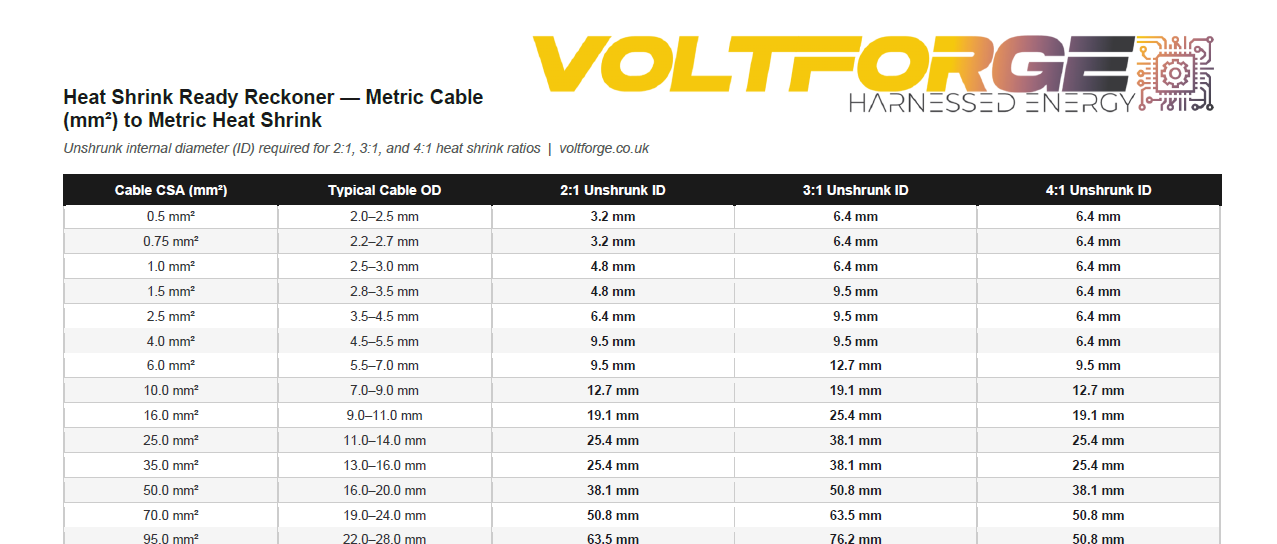
Heat shrink sizing tables for metric and AWG cable in 2:1, 3:1 and 4:1 shrink ratios — metric and imperial heat shrink sizes
This automotive heat shrink sizing guide is a rough and ready reference for selecting heat shrink tubing to fit standard automotive cable sizes. It is not a precision engineering document. OD data is derived from averages across the range of insulation types, wall thicknesses, and constructions commonly found in automotive and marine cabling. Real-world cable OD varies significantly by manufacturer, insulation compound, temperature rating, and application — so treat every figure in these tables as a starting point, not a final answer.
Start with the cable manufacturer datasheet or OEM specification. This is always the most accurate source — it accounts for production tolerances and the specific insulation construction of that cable.
Cross-reference with calipers. Measure the actual cable OD before ordering heat shrink.
On larger cables (25 mm² / 2 AWG and above), take 3–4 measurements at different positions along the cable and at different orientations. Average them. Larger cables can become slightly oval in cross-section after storage or bending.
Heat shrink unshrunk ID should be at least 1.1× the cable OD for a clean fit. Recovered ID must be smaller than the cable OD for a secure grip.
The authoritative standards for automotive cable construction and insulation classification are SAE J1127 (battery cables and welding cable) and SAE J1128 (low voltage primary cable). These are not freely published — they are available through SAE International — however they are not especially difficult to locate with a search engine and a few minutes of effort. If you are selecting heat shrink for a specific cable type in a regulated application, these are the references to consult for precise OD data.
If you are in the UK and would prefer not to pay for access, British Standards are available free of charge through the British Library’s Business & IP Centre network, based in public libraries across the UK. Individual users can read standards on site at no cost. If you are accessing as a registered business, in our experience the BIPC will email standards to you directly. A search for “Business and IP Centre” plus your nearest city will find your local access point.
We purchase heat shrink from RS Components, CPC, Farnell, and Hilltop Products. This is genuinely where our heat shrink comes from — we buy from all of them regularly. We have no commercial relationship with any of these suppliers beyond being customers. Your usual electrical wholesaler may stock equivalent product; always specify unshrunk internal diameter and shrink ratio when ordering.
Unshrunk internal diameter (ID) required for 2:1, 3:1 and 4:1 heat shrink ratios
| Cable CSA (mm²) | Typical Cable OD | 2:1 Unshrunk ID | 3:1 Unshrunk ID | 4:1 Unshrunk ID |
|---|---|---|---|---|
| 0.5 mm² | 2.0–2.5 mm | 3.2 mm | 6.4 mm | 6.4 mm |
| 0.75 mm² | 2.2–2.7 mm | 3.2 mm | 6.4 mm | 6.4 mm |
| 1.0 mm² | 2.5–3.0 mm | 4.8 mm | 6.4 mm | 6.4 mm |
| 1.5 mm² | 2.8–3.5 mm | 4.8 mm | 9.5 mm | 6.4 mm |
| 2.5 mm² | 3.5–4.5 mm | 6.4 mm | 9.5 mm | 6.4 mm |
| 4.0 mm² | 4.5–5.5 mm | 9.5 mm | 9.5 mm | 6.4 mm |
| 6.0 mm² | 5.5–7.0 mm | 9.5 mm | 12.7 mm | 9.5 mm |
| 10.0 mm² | 7.0–9.0 mm | 12.7 mm | 19.1 mm | 12.7 mm |
| 16.0 mm² | 9.0–11.0 mm | 19.1 mm | 25.4 mm | 19.1 mm |
| 25.0 mm² | 11.0–14.0 mm | 25.4 mm | 38.1 mm | 25.4 mm |
| 35.0 mm² | 13.0–16.0 mm | 25.4 mm | 38.1 mm | 25.4 mm |
| 50.0 mm² | 16.0–20.0 mm | 38.1 mm | 50.8 mm | 38.1 mm |
| 70.0 mm² | 19.0–24.0 mm | 50.8 mm | 63.5 mm | 50.8 mm |
| 95.0 mm² | 22.0–28.0 mm | 63.5 mm | 76.2 mm | 50.8 mm |
| 120 mm² | 26.0–32.0 mm | 76.2 mm | 101.6 mm | 63.5 mm |
| 150 mm² | 29.0–36.0 mm | 76.2 mm | 101.6 mm | 76.2 mm |
| 185 mm² | 33.0–41.0 mm | 101.6 mm | 127.0 mm | 76.2 mm |
| 240 mm² | 38.0–47.0 mm | 127.0 mm | 152.4 mm | 101.6 mm |
⚠ 25 mm² and 35 mm² share the same heat shrink size in all ratios. Always verify cable OD with calipers before ordering — see notes below.
Unshrunk internal diameter (ID) required for 2:1, 3:1 and 4:1 heat shrink ratios
| Cable Size (AWG) | Typical Cable OD | 2:1 Unshrunk ID | 3:1 Unshrunk ID | 4:1 Unshrunk ID |
|---|---|---|---|---|
| 28 AWG | 1.0–1.5 mm | 3.2 mm | 3.2 mm | 3.2 mm |
| 26 AWG | 1.2–1.7 mm | 3.2 mm | 3.2 mm | 3.2 mm |
| 24 AWG | 1.4–1.9 mm | 3.2 mm | 3.2 mm | 3.2 mm |
| 22 AWG | 1.6–2.2 mm | 3.2 mm | 6.4 mm | 3.2 mm |
| 20 AWG | 2.0–2.7 mm | 3.2 mm | 6.4 mm | 6.4 mm |
| 18 AWG | 2.5–3.3 mm | 4.8 mm | 6.4 mm | 6.4 mm |
| 16 AWG | 3.0–4.0 mm | 6.4 mm | 9.5 mm | 6.4 mm |
| 14 AWG | 3.5–4.8 mm | 6.4 mm | 9.5 mm | 6.4 mm |
| 12 AWG | 4.0–5.5 mm | 9.5 mm | 9.5 mm | 6.4 mm |
| 10 AWG | 5.0–6.5 mm | 9.5 mm | 12.7 mm | 9.5 mm |
| 8 AWG | 6.0–8.0 mm | 12.7 mm | 19.1 mm | 12.7 mm |
| 6 AWG | 7.5–9.5 mm | 12.7 mm | 19.1 mm | 12.7 mm |
| 4 AWG | 9.0–11.5 mm | 19.1 mm | 25.4 mm | 19.1 mm |
| 2 AWG | 11.0–14.0 mm | 25.4 mm | 38.1 mm | 25.4 mm |
| 1 AWG | 12.0–15.5 mm | 25.4 mm | 38.1 mm | 25.4 mm |
| 1/0 AWG | 13.5–17.0 mm | 25.4 mm | 38.1 mm | 25.4 mm |
| 2/0 AWG | 15.0–19.0 mm | 38.1 mm | 50.8 mm | 38.1 mm |
| 3/0 AWG | 17.0–21.5 mm | 38.1 mm | 50.8 mm | 38.1 mm |
| 4/0 AWG | 19.0–24.0 mm | 50.8 mm | 63.5 mm | 50.8 mm |
| 250 kcmil | 22.0–27.5 mm | 63.5 mm | 76.2 mm | 50.8 mm |
| 300 kcmil | 24.0–30.0 mm | 76.2 mm | 101.6 mm | 63.5 mm |
| 350 kcmil | 26.0–32.5 mm | 76.2 mm | 101.6 mm | 76.2 mm |
| 400 kcmil | 28.0–34.5 mm | 101.6 mm | 127.0 mm | 76.2 mm |
| 500 kcmil | 31.0–38.5 mm | 101.6 mm | 127.0 mm | 76.2 mm |
⚠ AWG OD values are indicative only. kcmil = thousand circular mils (US large conductor sizing). Always verify with calipers.
Unshrunk internal diameter (ID) required for 2:1, 3:1 and 4:1 heat shrink ratios — imperial fractional inch sizes
| Cable Size (AWG) | Typical Cable OD (in) | 2:1 Unshrunk ID | 3:1 Unshrunk ID | 4:1 Unshrunk ID |
|---|---|---|---|---|
| 28 AWG | 0.040″–0.059″ | 1/8″ | 1/8″ | 1/8″ |
| 26 AWG | 0.047″–0.067″ | 1/8″ | 1/8″ | 1/8″ |
| 24 AWG | 0.055″–0.075″ | 1/8″ | 3/16″ | 1/8″ |
| 22 AWG | 0.063″–0.087″ | 1/8″ | 1/4″ | 1/8″ |
| 20 AWG | 0.079″–0.106″ | 1/8″ | 1/4″ | 1/4″ |
| 18 AWG | 0.098″–0.130″ | 3/16″ | 1/4″ | 1/4″ |
| 16 AWG | 0.118″–0.157″ | 1/4″ | 3/8″ | 1/4″ |
| 14 AWG | 0.138″–0.189″ | 1/4″ | 3/8″ | 1/4″ |
| 12 AWG | 0.157″–0.217″ | 3/8″ | 3/8″ | 1/4″ |
| 10 AWG | 0.197″–0.256″ | 3/8″ | 1/2″ | 3/8″ |
| 8 AWG | 0.236″–0.315″ | 1/2″ | 3/4″ | 1/2″ |
| 6 AWG | 0.295″–0.374″ | 1/2″ | 3/4″ | 1/2″ |
| 4 AWG | 0.354″–0.453″ | 3/4″ | 1″ | 3/4″ |
| 2 AWG | 0.433″–0.551″ | 1″ | 1-1/2″ | 1″ |
| 1 AWG | 0.472″–0.610″ | 1″ | 1-1/2″ | 1″ |
| 1/0 AWG | 0.531″–0.669″ | 1″ | 1-1/2″ | 1″ |
| 2/0 AWG | 0.591″–0.748″ | 1-1/2″ | 2″ | 1-1/2″ |
| 3/0 AWG | 0.669″–0.846″ | 1-1/2″ | 2″ | 1-1/2″ |
| 4/0 AWG | 0.748″–0.945″ | 2″ | 2-1/2″ | 2″ |
| 250 kcmil | 0.866″–1.083″ | 2-1/2″ | 3″ | 2″ |
| 300 kcmil | 0.945″–1.181″ | 3″ | 4″ | 2-1/2″ |
| 350 kcmil | 1.024″–1.280″ | 3″ | 4″ | 3″ |
| 400 kcmil | 1.102″–1.358″ | 4″ | 5″ | 3″ |
| 500 kcmil | 1.220″–1.516″ | 4″ | 5″ | 3″ |
⚠ Imperial heat shrink sizes are nominal unshrunk internal diameter in fractional inches. kcmil = thousand circular mils.
⚠ Always consult the cable manufacturer datasheet or OEM specification first — this accounts for production tolerances and insulation wall variation between manufacturers and cable types (automotive, marine, welding). Verify with calipers before ordering. On larger cables (25 mm² / 2 AWG and above) take 3–4 measurements at different positions and orientations along the cable and average them — cables can become slightly oval after storage or bending. Unshrunk ID should be ≥1.1× cable OD for easy fitting; recovered ID must be smaller than cable OD for secure grip.
This document is provided for general reference and educational purposes only. The figures and guidance contained in it are derived from published industry standards and averaged data across commonly available cable constructions — they are not a substitute for measurement of the specific cable you are working with. Heat shrink selection involves variables that no general reference document can fully account for: cable OD variation by manufacturer, insulation wall thickness, insulation compound, and storage or installation conditions all affect the correct choice. It is the responsibility of the installer to verify sizing against the actual cable before committing to a purchase or installation. Voltforge and Zeromachine Ltd accept no liability for loss, damage, or consequential loss arising from the use of or reliance on the information in this document. If in doubt, measure first.
If you need a complete connector assembly rather than individual components, our pre-built Deutsch DT pigtail kits arrive ready to install — correct cable spec, correct contacts, correct seals. Browse the pigtail range →