Address
Blyth, Northumberland
U.K. NE24 2QW
Telephone
+44(0)1670 336766
Opening Hours
Monday to Friday: 08:00 - 17:30

Conductor classes, stranding construction, tri-rated cable, and 230V AC cable for leisure vehicles. Why the cross-sectional area figure only tells you part of the story — and why the wrong cable in a vehicle installation is a fault waiting to happen.
Automotive cable conductor classes, stranding, tri-rated cable, AC cable for leisure vehicles, and why the number on the cable only tells you part of the story
When someone says they need 2.5 mm² cable, they are specifying the cross-sectional area of the conductor. That number determines current carrying capacity and resistance. It tells you almost nothing about how the conductor is built, how flexible the cable is, or how long it will last in a vehicle application. For that, you need to understand conductor class.
IEC 60228 defines conductor classes for copper and aluminium conductors. The class number describes how the conductor is stranded — specifically, how many individual wires make up the conductor and how fine they are. The higher the class number, the finer and more numerous the strands, and the more flexible the finished cable.
Class 1 — solid conductor. A single copper wire. Rigid, inflexible, suitable only for fixed building installations. Not for vehicle use under any circumstances. A solid conductor in a vehicle will work-harden and fracture at vibration points. It is also very difficult to terminate cleanly into crimp ferrules and connector contacts.
Class 2 — stranded conductor. Multiple strands, but relatively few and relatively coarse. Better than Class 1, but still stiff and difficult to work with in tight bends. Used in fixed wiring where some flexibility is needed. Not recommended for vehicle installations where cable is expected to flex or where termination quality matters.
Class 5 — fine stranded flex. The automotive standard. Many fine strands. Genuinely flexible, easy to route, kinder to crimp contacts and connector terminals, and significantly more resistant to vibration fatigue at termination points. This is what OEM automotive harnesses use. This is what Voltforge uses in its assemblies. If you are buying cable for a vehicle installation and the supplier cannot tell you the conductor class, buy from someone who can.
Class 6 — extra fine stranded flex. Even finer strands than Class 5. Used in applications requiring exceptional flexibility — battery leads, welding cable, trailing leads, and applications where the cable is in continuous movement. Also used in some high-end automotive harness work. The right choice for battery interconnects and anything that flexes repeatedly in service.
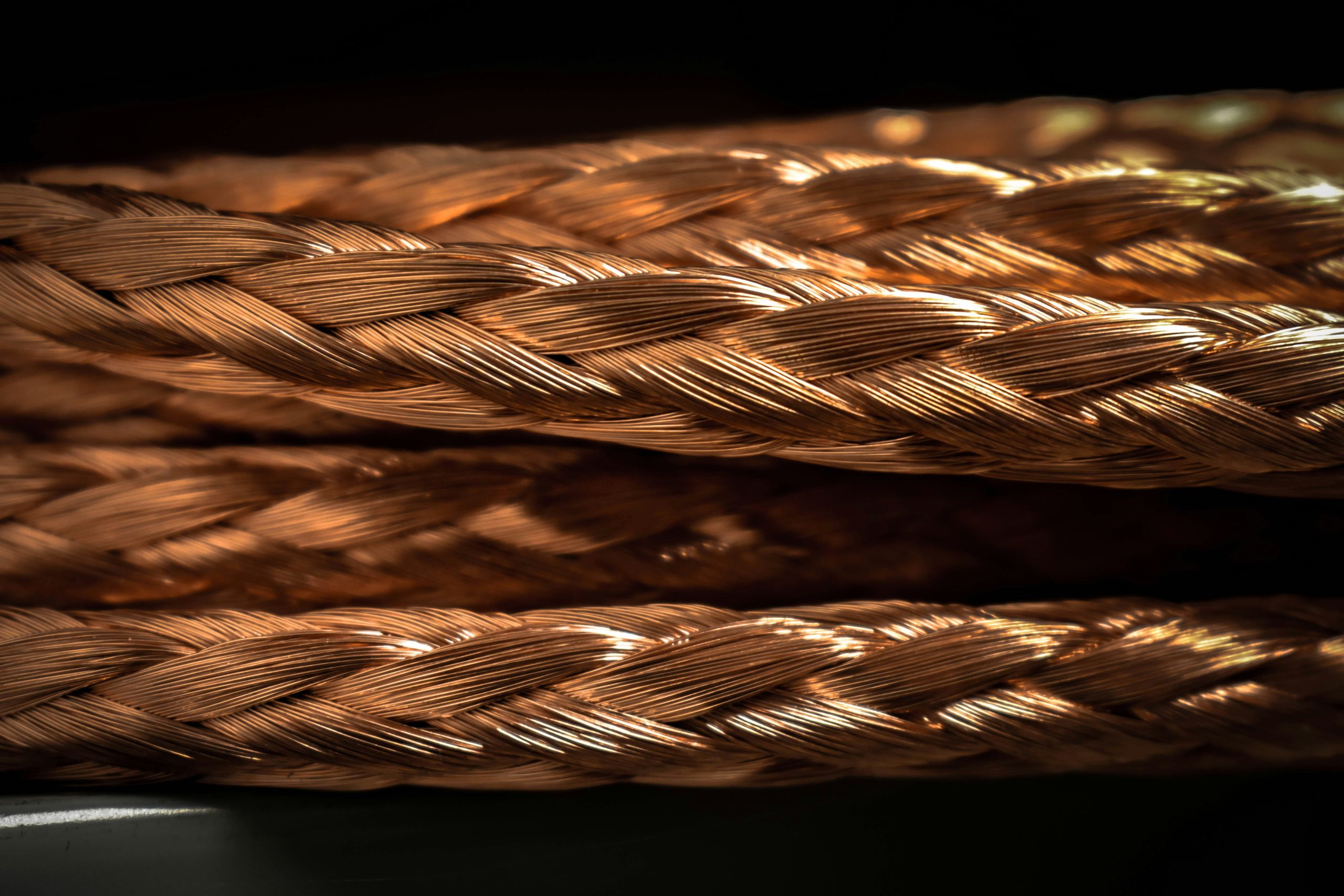
A stranded conductor is not just a bundle of wires pushed into an insulation tube. The individual strands are twisted together in a controlled way, and the geometry of that twist — the lay — determines the mechanical and electrical behaviour of the finished cable. A consistent, controlled lay is what allows the conductor to flex without the strands working against each other or migrating through the cross-section over time.
Bunched stranding. All strands twisted together in the same operation with no organised geometric arrangement. Simple and economical. The strands do not sit in a fixed relationship to each other, which makes the OD less consistent and the crimp behaviour less predictable.
Concentric stranding. Strands arranged in concentric layers around a central core wire, each layer twisted in the opposite direction to the one below. This is the construction used in quality automotive cable. It produces a consistent cross-section, a predictable OD, better compression behaviour in a crimp, and better fatigue resistance because each layer is mechanically supported by the layer beneath it.
Rope-lay construction. Used in Class 6 extra-flexible cable. Groups of strands are first twisted into small sub-bundles, and those sub-bundles are then twisted together in the opposite direction to form the conductor. The result is exceptionally fine and flexible with very high fatigue resistance. This is the construction found in battery interconnects and welding cable.
Automotive cable datasheets express conductor construction in two ways: as a class number (Class 5, Class 6) or as a strand count and strand diameter notation. Both tell you the same thing in different ways.
The strand count / diameter notation looks like this: 32 × 0.20 — meaning 32 individual strands each 0.20 mm in diameter, giving a nominal cross-sectional area of approximately 1.0 mm². A Class 2 conductor of the same nominal CSA might be expressed as 7 × 0.43 — the same total copper area but seven coarse strands that will behave entirely differently in a crimp and under vibration. If a supplier cannot give you the strand count and diameter, ask why not.
Typical strand count and diameter combinations for Class 5 automotive flex: 0.5 mm² — 16 × 0.20 mm; 1.0 mm² — 32 × 0.20 mm; 2.5 mm² — 50 × 0.25 mm; 4.0 mm² — 56 × 0.30 mm; 6.0 mm² — 84 × 0.30 mm; 10.0 mm² — 80 × 0.40 mm. The difference compared to a Class 2 conductor of the same nominal CSA is visible to the naked eye once you know what you are looking for.
Strip back about 20 mm of insulation and look at the conductor end-on. Fine-stranded Class 5 cable has a conductor that looks almost smooth — the individual strands are so small that the cross-section appears almost solid until you look closely. A coarse-stranded or Class 2 conductor will show clearly visible individual wires, often arranged in a recognisable hexagonal pattern of concentric rings.
You can also flex a short stripped length between your fingers. Fine-stranded cable moves easily and springs back without any tendency to kink. Coarse-stranded cable feels stiffer and will hold a bend rather than returning to its original shape. If it feels like bending a coat hanger, do not put it in a vehicle.
BS 6004 flat twin and earth is immediately identifiable — flat grey profile, two or three cores with visible bare earth, rigid enough to hold its shape. There is no circumstance in which this belongs in a vehicle DC installation.
The conductor class has a direct effect on termination quality. A crimp contact — whether a bootlace ferrule, a ring terminal, or a Deutsch DT contact — is designed to compress a conductor to a specific cross-sectional geometry. Fine-stranded Class 5 conductor fills the contact barrel evenly, compresses cleanly, and produces a gas-tight cold weld that resists corrosion and vibration loosening. Coarse-stranded or solid conductor does not fill the barrel the same way, leaves voids, and produces a termination that may look acceptable initially but will corrode and loosen over time under vehicle vibration.
This is not theoretical. Intermittent faults at poorly terminated connections are one of the most common and most time-consuming electrical problems in vehicle installations. They are also among the hardest to find. The fix is to use the right cable from the start.
When a conductor flexes, each strand is subjected to tensile and compressive stress alternately on opposite sides of the bend. In a coarse-stranded conductor, each strand carries a larger share of the total mechanical load, and the stress at the outer fibre of each strand is higher. In a fine-stranded conductor, the same total mechanical load is shared across many more strands, each experiencing lower stress per cycle. Lower stress per cycle means more cycles before fatigue failure.
The failure mode is worth understanding. Fatigue failure in a conductor does not usually appear as a sudden complete break. It begins as microscopic cracks in individual strands at the point of highest stress — typically where the conductor enters a crimp terminal or passes through a cable support. Those strands break one by one over time, each one increasing the current density and thermal load on the remaining strands, which accelerates their fatigue. The result is a progressive resistance increase at the termination point that produces exactly the kind of intermittent, temperature-dependent, hard-to-find fault that makes vehicle electrical diagnosis so frustrating.
Fine-stranded Class 5 cable pushes the fatigue life far enough out that a well-made installation should outlast the vehicle. Coarse-stranded cable in a high-vibration environment may not.
Tri-rated cable is a single-core, fine-stranded flexible cable carrying three approvals: BS EN 60228 Class 5, UL 508 and CSA 22.2. It takes its name from those three approvals, not from any particular construction characteristic. The conductor is Class 5 fine-stranded copper, typically with 105°C PVC insulation, and it is manufactured to a consistent standard with good dimensional tolerances.
It is widely used in control panel wiring, switchgear, and industrial electrical work, and it turns up regularly in automotive and leisure vehicle installations — partly because it is available from electrical wholesalers in an extensive colour range that genuine automotive cable often is not, and partly because it is a quality product that is genuinely easy to work with. The Class 5 conductor construction means it terminates well, routes easily, and handles vehicle vibration without the fatigue problems associated with coarser-stranded cable. It is a legitimate choice for interior, protected DC runs in a vehicle where the cable will not be exposed to fuel, oil, UV radiation or extreme heat.
The caveats are straightforward. Tri-rated cable is not formulated or tested to automotive insulation standards — the PVC compound is designed for switchgear and panel environments, not engine bays, wheel arches or external runs where fuel, oil, UV and temperature cycling are normal. For under-bonnet runs, external runs or any location where the cable is exposed to the full automotive environment, use cable specified and tested to SAE J1128 or ISO 6722 with an appropriate temperature rating. For those applications, tri-rated is the wrong tool.
Used in the right place — interior protected DC runs in a campervan or leisure vehicle, control wiring in a panel or enclosure, low-voltage signalling in a protected loom — tri-rated cable is a sound and practical choice.
BS 6004 and BS 6231 fixed installation cable — flat twin and earth, singles and multicore building wire — is not automotive cable. It may carry the correct current for the job. It will not survive vehicle life. Building wiring is typically Class 1 or Class 2, designed for a fixed installation in a wall or ceiling where it will never move. It uses PVC insulation compounds formulated for ambient indoor temperatures, not the thermal cycling, UV exposure, oil, moisture and vibration that a vehicle environment delivers. It is also not designed for the crimp terminations used in automotive connectors — attempts to crimp BS 6004 / BS 6231 cable into automotive contacts produce poor-quality joints that will fail.
The cost difference between fixed installation cable and proper automotive cable is small. The cost of re-doing a poor installation — in time, materials and diagnostic frustration — is not.
A reputable automotive cable supplier will be able to tell you the conductor class, the insulation type and temperature rating, the insulation wall thickness, and the overall cable OD. The cable itself should be marked with its cross-sectional area, voltage rating and insulation type at regular intervals along the jacket. If a cable has no markings, or the markings are vague, that tells you something about how it was made.
For leisure vehicle and campervan work, specify Class 5 fine-stranded automotive flex with 105°C PVC insulation as a minimum. For under-bonnet, engine bay or high ambient temperature applications, specify 125°C XLPE or XLPO insulated Class 5 or Class 6 cable. See our Ampacity Ready Reckoner and Heat Shrink Sizing Guide for cable OD data and current ratings across insulation types.
Everything above applies to DC wiring. The 230V AC system in a leisure vehicle is a different discipline with different standards, different cable types and a different regulatory framework. This section is a brief orientation, not a complete guide — 230V work in leisure vehicles should always be carried out by a competent person with a working understanding of BS 7671.
Fixed wiring — flexible twin and earth. Where 230V cable is run as fixed wiring between consumer units, sockets and permanently connected equipment, use flexible twin and earth — 3183Y or 3092Y. Not BS 6004 solid flat twin and earth as used in domestic building wiring. BS 6004 flat T&E is a Class 1 or Class 2 conductor designed for a fixed installation in a wall or ceiling. It will work-harden and fracture at vibration points, crack at bends, and is not fit for a vehicle. The minimum size for a leisure vehicle 230V circuit is 1.5 mm² flexible twin and earth (3183Y). Size up for higher current circuits — electric water heaters, air conditioning units, inverter outputs — in accordance with BS 7671 and the load.
Flexible connections — rubber or thermoplastic flex. For portable appliances, trailing leads, and any connection that flexes in use, use appropriately rated rubber or thermoplastic flexible cord — HO5VV-F for indoor protected use, HO7RN-F for external, damp or exposed locations. Minimum 1.5 mm² for general circuits; 2.5 mm² for higher current loads.
Never use solid flat twin and earth (BS 6004 T&E) in a vehicle under any circumstances. It is a Class 1 or 2 conductor in a PVC compound designed for a wall or ceiling. It will work-harden and fracture at vibration points, and it is simply not fit for a vehicle installation regardless of how convenient it is to source.
230V AC work in a leisure vehicle is subject to BS 7671 (the IET Wiring Regulations) and, for leisure vehicles specifically, BS EN 1648. New installation work should be accompanied by an Electrical Installation Certificate issued by a registered competent person. If you have any concerns about an existing 230V installation, stop and get it checked before connecting to shore power.
| Class | Stranding | Flexibility | Typical use | Vehicle use |
|---|---|---|---|---|
| 1 | Solid — single wire | None | Fixed building installations only | Never |
| 2 | Stranded — few, coarse wires | Low | Fixed building and industrial wiring | Not recommended |
| 5 | Fine stranded flex — many thin wires | High | Automotive, leisure vehicle, marine, OEM harnesses | Yes — specify this |
| 6 | Extra fine stranded flex | Very high | Battery leads, welding cable, continuously flexing applications | Yes — for battery leads and flex applications |
This document is provided for general reference and educational purposes only. The guidance contained in it is intended to support informed decision-making and does not constitute engineering advice for a specific installation. It is the responsibility of the installer to verify the suitability of any cable, component or termination method for their specific application and to ensure that any installation complies with applicable standards, regulations, and vehicle or equipment manufacturer requirements. Voltforge and Zeromachine Ltd accept no liability for loss, damage, injury or consequential loss arising from the use of or reliance on the information in this document.
Every Voltforge assembly is built with Class 5 fine-stranded automotive flex and OEM-spec contacts throughout — because the cable spec matters as much as the connector. Browse the Deutsch DT pigtail range →